From brief to first article in four steps.
You work with one engineer, in files and on calls, from wherever you are. Each step ends in a document you own. You can stop after any of them and take the work elsewhere.
-
Brief
A call and whatever you have: a STEP file, sketches, a prototype on a desk. We write down the load case, the environment, the quantity, the target unit cost and the constraints that are not negotiable. If nobody has set a requirement, I propose one and label it as a proposal.
You get a one-page requirement and a fixed quote for the next step.
-
Design review
The model is checked against the published rules of the process it will be made with. That covers minimum wall and floor, internal radii against tool diameter, hole depth, draft, threads, tolerance classes to ISO 2768 and fits to ISO 286, and anodise growth on fits and threads. Every finding names its source. A number without one is marked unverified, with the supplier question that would settle it.
You get a written report with markup, and the questions each supplier must answer.
-
Prototype on the production process
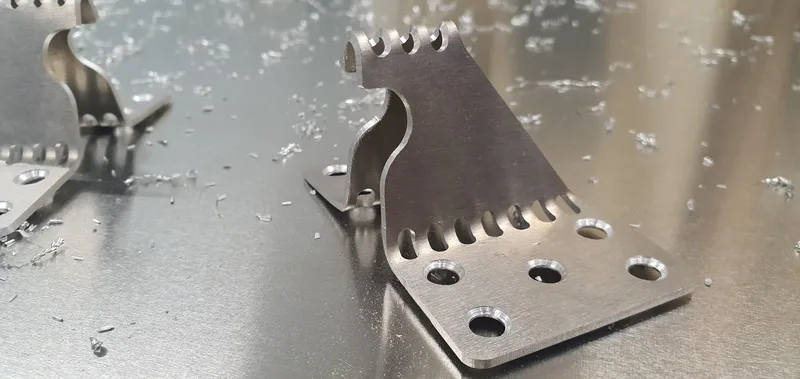
A 3D print proves a shape. A first article machined from the production alloy, and finished by the shop that will do the batch, proves the part and the process together. Small parts can be cut and finished in the workshop in Mosfellsbær. The rest go to the supplier short-listed for production, so the prototype is also that supplier's trial.
You get parts, measurements against the drawing, and the list of what changes for production.
-
Sourcing and audited handover
The RFQ goes to about ten suppliers with the same pack. Quotes are compared line by line, including lead time, tooling, finish and freight. After sample approval and first-article inspection, every file goes through the handover audit: geometry, leftover features, interference at tolerance limits, and the drawing checked against the model.
You get a supplier, a price and a release pack that passed the audit, with the audit table attached.
What you work with
- Files
- STEP, native parametric models, PDF drawings, DXF for flat parts.
- Calls
- Any video tool you already use. A phone pointed at the part is enough.
- Time zone
- Iceland is on UTC all year: most of the European working day and the US East Coast morning.
- Paperwork
- AI-assisted drafting of RFQs and reports; an engineer reviews every step.
- Confidentiality
- A mutual NDA before any file is opened, if you want one. Client work stays off this site unless the client agrees in writing.
Start with the review.
One part, €450, fixed, and credited against the prototype.